Greetings,
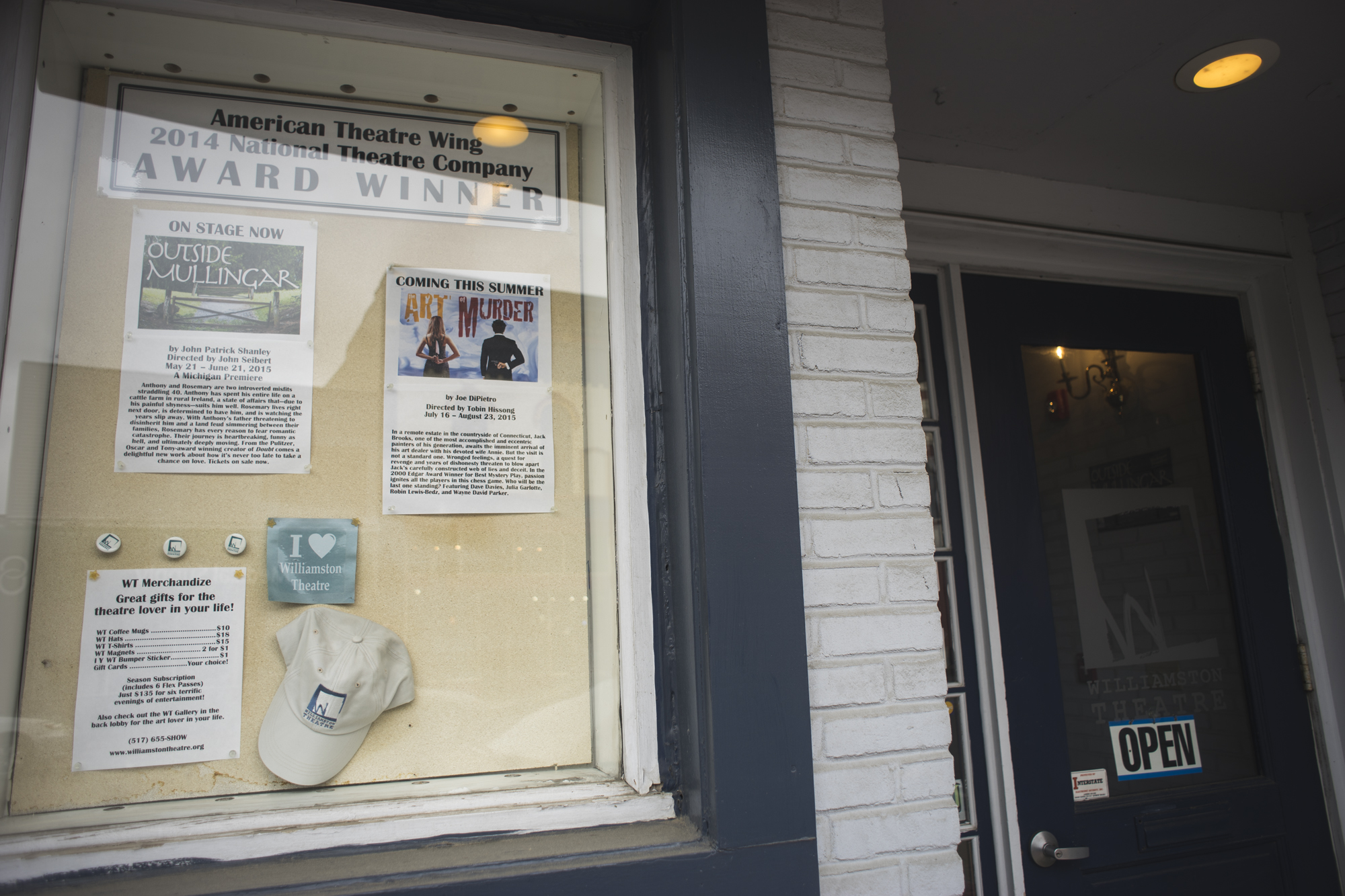
Sunday we took a trip out to Williamston Theatre, a Small Professional Theatre Equity house about an hour outside the city, where we saw John Patrick Shanley’s Outside Mullingar.
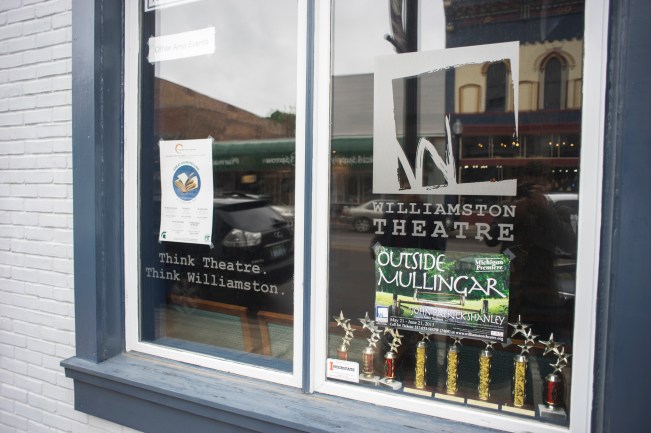
As I typed the name of the play I was reminded of how absolutely enthralled and affected I was. This was hands down the most technically proficient and heartfelt performance we’ve seen during our trip.
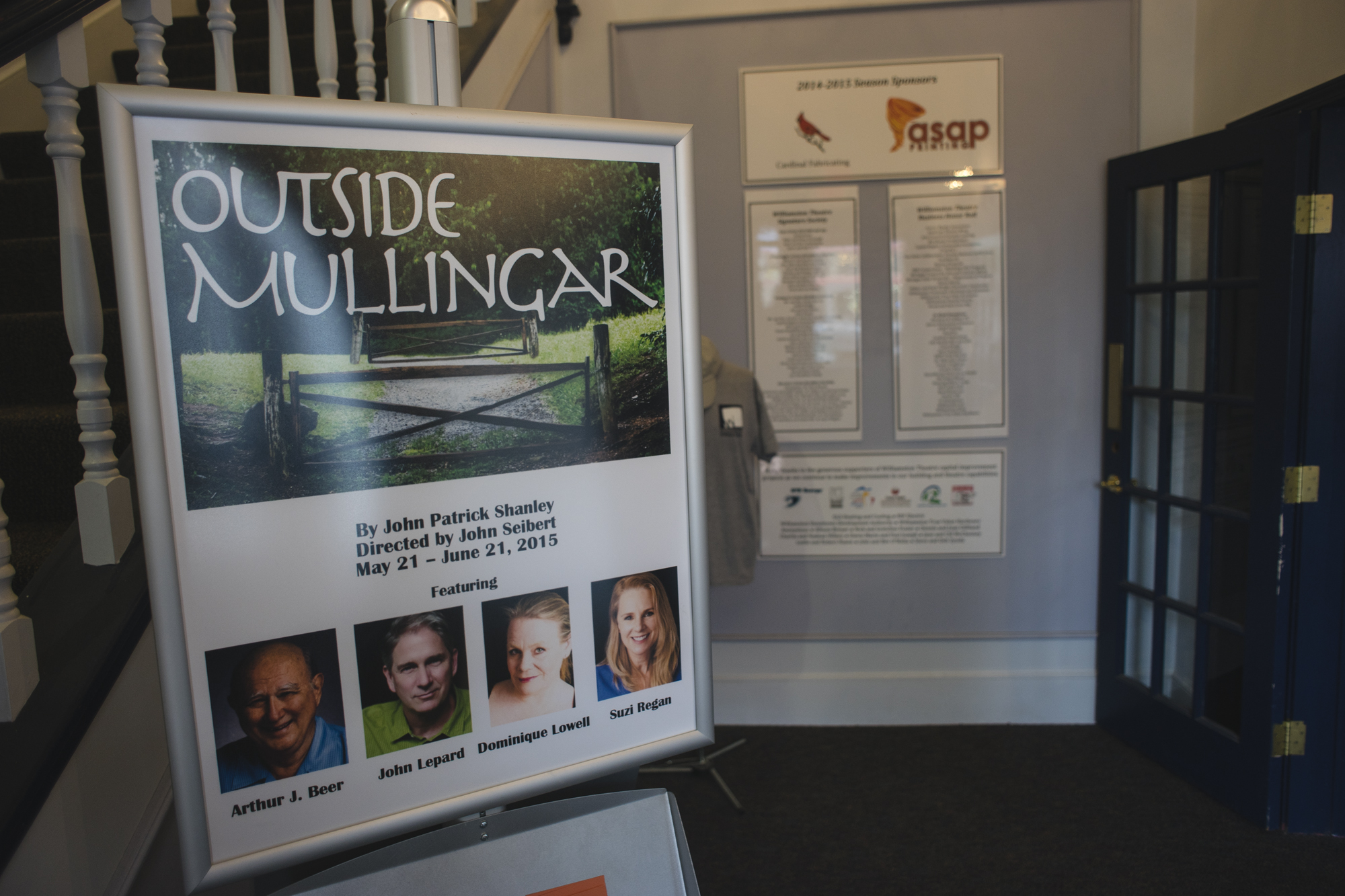
The play is set in present day Ireland — so there were accents. It was so refreshing to hear the accent done well, (especially knowing these actors did not have a dialect coach).
But that brings up another thing: it’s dicey to do an Irish play for an ethnically diverse audience base. In fact, their entire season is comprised of plays by white people, and only one by a woman.
But this is no accident, they know their audience: we were by far the youngest in the house and Ryan was the most diverse. Not surprising knowing that Williamston is 94% white (there are 36 African American residents).
Furthermore, the lady next to Ryan drove over 80 miles to see the show. That’s the result of 11 years of advertising and cultivating an audience.
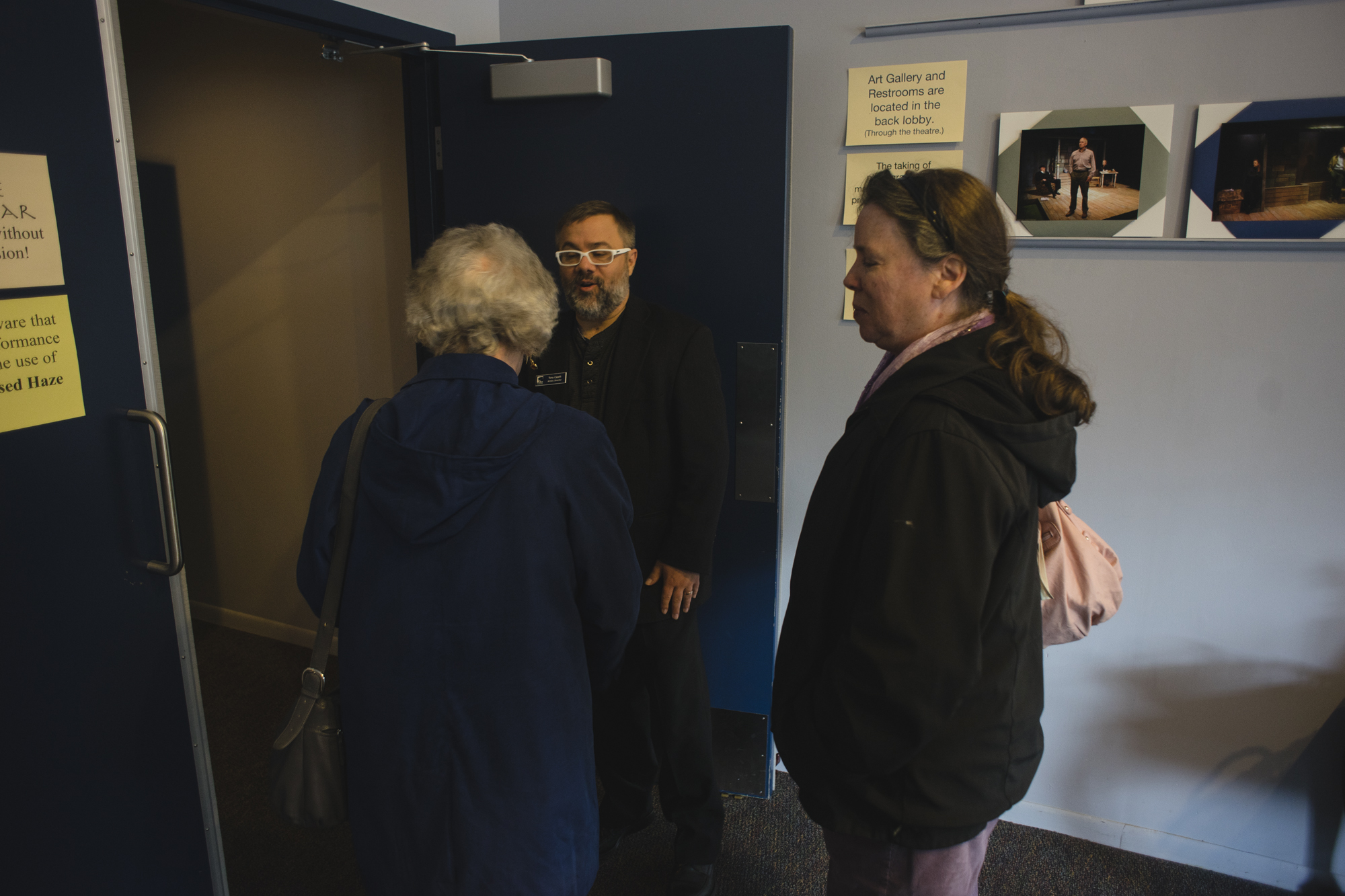
Tony with the cool frames.
As the lights fell Artistic Director Tony Caselli hopped onstage to announce the show. He assured the audience that the haze effect is safe: “It’s exactly like being at Woodstock: breathe deep.” The joke worked, everyone laughed — he knows his audience. He also mentioned some awards they won recently: “The Williamston Theatre was recently awarded grants from the Michigan Council for the Arts and Cultural Affairs (MCACA) and the Capital Region Community Foundation. The theater was also recognized by the American Theatre Wing as one of the most promising young theatre companies in the country” (article, Capital Gains Media).
After the play we sat down with Tony to talk business.
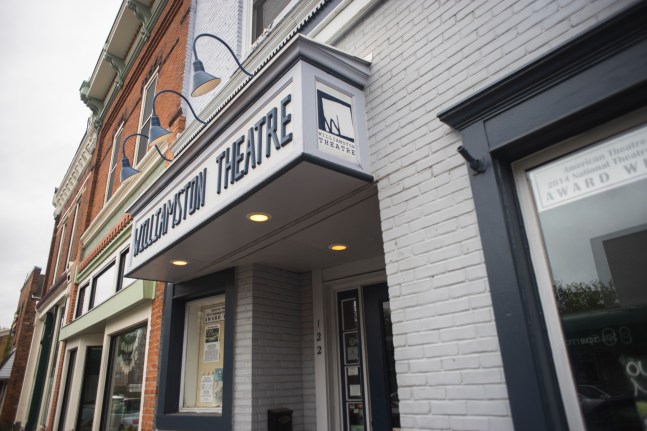
They just bought the building in 2014 at a great price from a landlord who was apparently a dream to rent from. Tony co-founded the theatre in 2004 with three others (one of whom, John Lepard played the lead). Before that, Tony was the Associate Artistic Director at Purple Rose Theatre Company, founded by Jeff Daniels in 1991 in Chelsea, MI.
He described Williamston Theatre’s niche as “warm human comedies” meant to make people “laugh and cry and leave wanting to call the people they love.” He said that this is what people want; “you are not going to get people to come see Sartre’s No Exit…blend in the challenging stuff with more populist work…we’re in Michigan, which is not very metropolitan even in the metropolitan areas.”
By “metropolitan” he means dense in population; there aren’t a whole lot of people, meaning fewer potential audience members.
So should that deter us? Or do we just do the work we want to do?
Let’s be honest, we can’t just “do the work we want to do”. That would be self-indulgent. The work has to resonate to truly be worth doing, and we definitely want that. However, we have to put our ear to the ground a bit more in a new place, since we’re unfamiliar with the culture and the social dialogue. And even in Winston-Salem we would still have to satisfy an audience base.

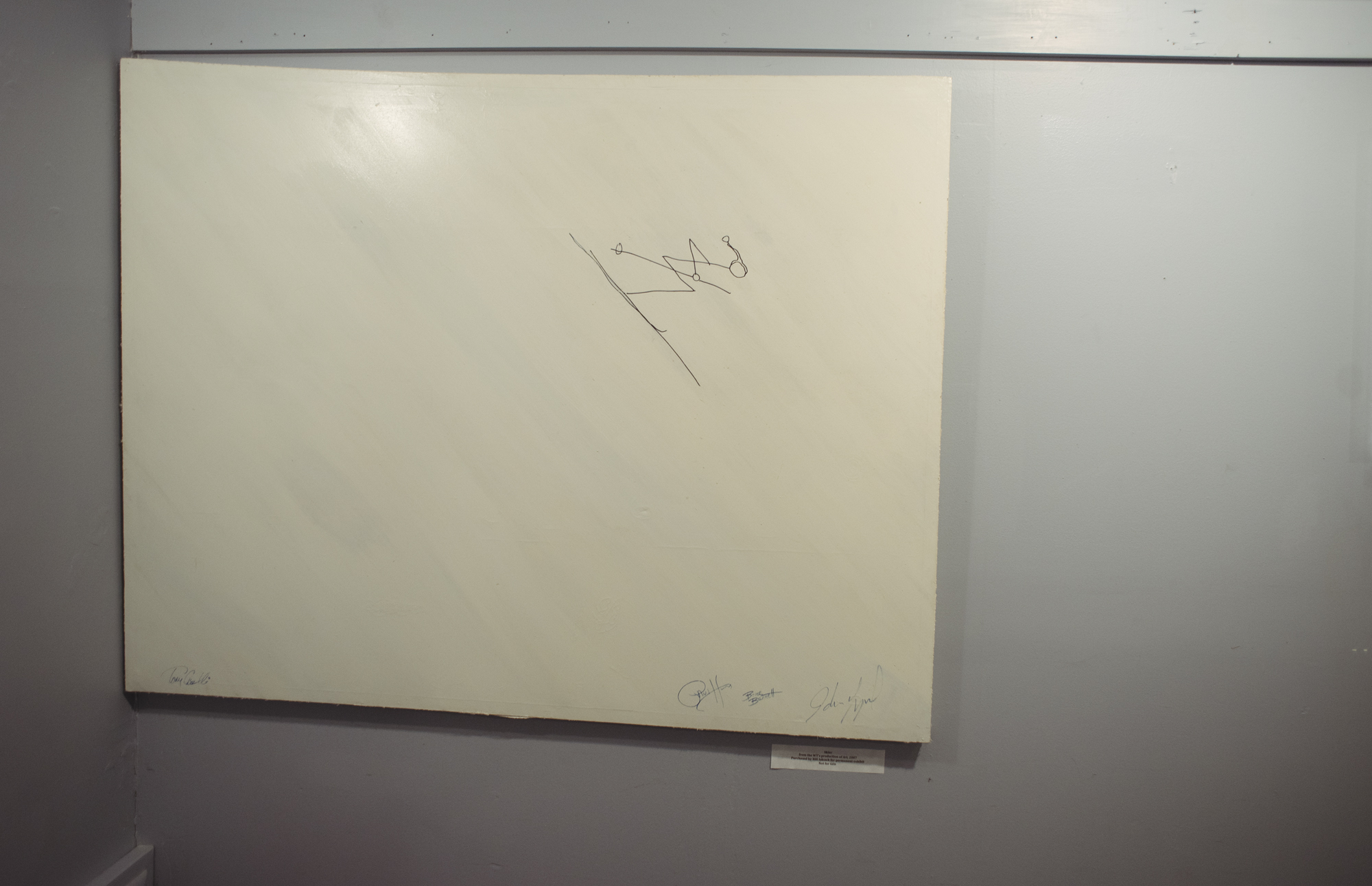
Art Gallery in Williamston’s space
If you only work for you, you won’t make money. And while we’re not money-grubbing fiends we’d rather not have to rearrange our lifestyles to accommodate abject poverty.
That’s why we’re in Detroit to begin with: we’re nobodies with a lot of skill and talent trying to become somebodies.
And as a nobody starting out, you don’t have enough clout to get a directing job immediately. So we asked Tony how we could be hired to direct in other theaters (which we’d do in the off-months between one summer and the next). His advice: “Get your foot in the door somehow.” Right after college he worked as a stage manager to work and observe other directors processes. He also said that he had an assistant who started by volunteering 15 hours a week; now she directs at least one show a season.
Good lesson in persistence and saying “yes”.
He also spoke about the importance of community within theaters. “We trade comps with every Equity theater in the state.” This means they’re in communication, and his kind of community could turn into collaboration (since they’re not in competition).
Tony mentioned the the growing popularity of co-productions; saves money and you get to know other theaters’ designers. He said that this would be a good thing for us to try, maybe with some of the smaller semi-pro companies in the area.
And he says the area is fertile: “95% of our talent comes from the state…our reasons are financial, we have no place to house them.” Plus, his theater is trying to do work that’s “by, for and of the people in the community”; what better way to do that than employing local actors? Not only that, but they mostly live in the metro Detroit area. That bodes really well for us: this production was phenomenal, and if we can find actors like this in metro Detroit we are in business.
Most of these actors were Equity, though. An Equity actor has to get approval from the Actor’s Equity Association to work in a non-Equity house (which we would be starting out). However, the reverse is not true. According to Tony “as an SPT (Small Professional Theatre), half of our cast over the course of the season has to be Equity.” Not show, but season. That leaves a good deal of wiggle room. But if we start out as non-Equity it’ll be much harder to hire Equity actors. Of course, there is a lot of amazing non-union talent out there, generally younger actors who deserve an Equity card but don’t have enough points; they’re just harder to find.
Williamston Theatre also has a relationship with Michigan State University students and faculty. Tony says “I teach a class, direct a show, and we do shows with student opportunities” like design and stage management positions. They have an apprenticeship program (like JET) in which students can earn Equity points working on shows as stage hands and the like.
This would be a wonderful thing for us to do, however it’s unlikely that we have enough clout to work in higher education rather than elementary, middle and high schools. Ryan and I will have BFAs, but you generally need an MFA before colleges will give you a class of undergrads. And although we are very interested in working with public schools, colleges would offer the opportunity to hire out of the student body much easier and sooner.
This was a very eye-opening conversation. Thank you, Tony, for giving us the time and advice.
And thank you for reading about it.
All the best,
R&R


Hey guys – great blog. I think your project is terrific.
Tony Caselli here, from Williamston Theatre, mentioned in the posting above. I’m posting just to correct some possible misconceptions from the article.
Interestingly, you took my “Not very metropolitan” comment to be about the *type* of people in our cities, when I meant it to be about the *amount* of people. I don’t think you meant anything by it, but I think this is an important distinction. Our metropolitan areas are much smaller than the major market cities of, say, Chicago or New York. We have a Detroit (which, unfortunately, doesn’t house the population it once did), a Grand Rapids, a Flint, an Ann Arbor. The PEOPLE there are terrific, and your term “stick in the mud” is not a term that comes to mind when thinking of them – especially considering some of the wonderful theatre that DOES go on in those areas, and in places like Northville, Ferndale, Hamtramck, several cities on the West side of the state and elsewhere.
The point I was making about “No Exit” in our discussion was to say, simply, that although there are people who would come to see it, there probably aren’t, in the target geography of Williamston Theatre, *enough* fans of existentialism for us to successfully do a 6-week run of that show without losing a lot of money. A major metropolitan market like New York or Chicago probably has the same *percentage* of population who would come see it, but because the population is so much larger, they’d have much bigger attendance compared to what we’d get.
(Incidentally, the reason “No Exit” came up is because we ARE including it in our season next year, in a smaller fashion: We do a staged reading series called “Dark Nights in Billtown”, specifically to explore work that we think is interesting but not something we could do a full 6-week run of. These are short runs of staged readings -one weekend- that we DO have enough interested audience to fill. Next year we’re doing a weekend of existentialist pieces and a weekend of protest theatre.)
Just wanted to clarify that, fellas, because I thought it was important. “Stick in the mud” is definitely not how I’d describe the audiences that support the wide variety of art and entertainment being offered throughout Michigan. The styles, subjects, aesthetics, platforms, genres, storytelling and messages being both offered and embraced by various communities is wonderfully diverse. Make sure, in your research, not to lose sight of that. 🙂
Thanks for coming out to Williamston, guys – and best of luck with your project!
Tony
Tony Caselli
Artistic Director
Williamston Theatre
LikeLike
Hey Tony!
Thanks for checking out the blog, and thanks for your comment. We appreciate the clarification and have made some appropriate edits.
It’s interesting the different uses of a word like “metropolitan” and I was very intrigued by the point I thought you were making lol. I’m glad to know your thoughts in more detail; very apt to our purpose. It’s true that a denser population means a larger number of all kinds of people, including more of the kinds of people interested in theatre. Of course, it also means more people not interested in theatre — but even they provide an opportunity to gain more audience members, for example the people who came to see your baseball play.
Best of luck with your work on “No Exit”; I hope you find that there is enough interest to fully produce that amazing bit of theatre.
All the best,
Rory
LikeLike