R&R: Good evening,
We are here in the Motor City with a special broadcast brought to you from the living room of Kirk Goodlow, Detroit’s resident (living) saint and bodybuilding extraordinaire. Tonight we will be discussing the perspectives of many well-known Detroiters, both native and transplant, regarding the influx of businesspeople and artists moving to and thriving in the city over the last few years. Stay tuned.
But before that, let’s hear from Detroit theatre maker, actor, teacher and activist Emilio Rodriguez who was featured in last night’s Bad Jews.
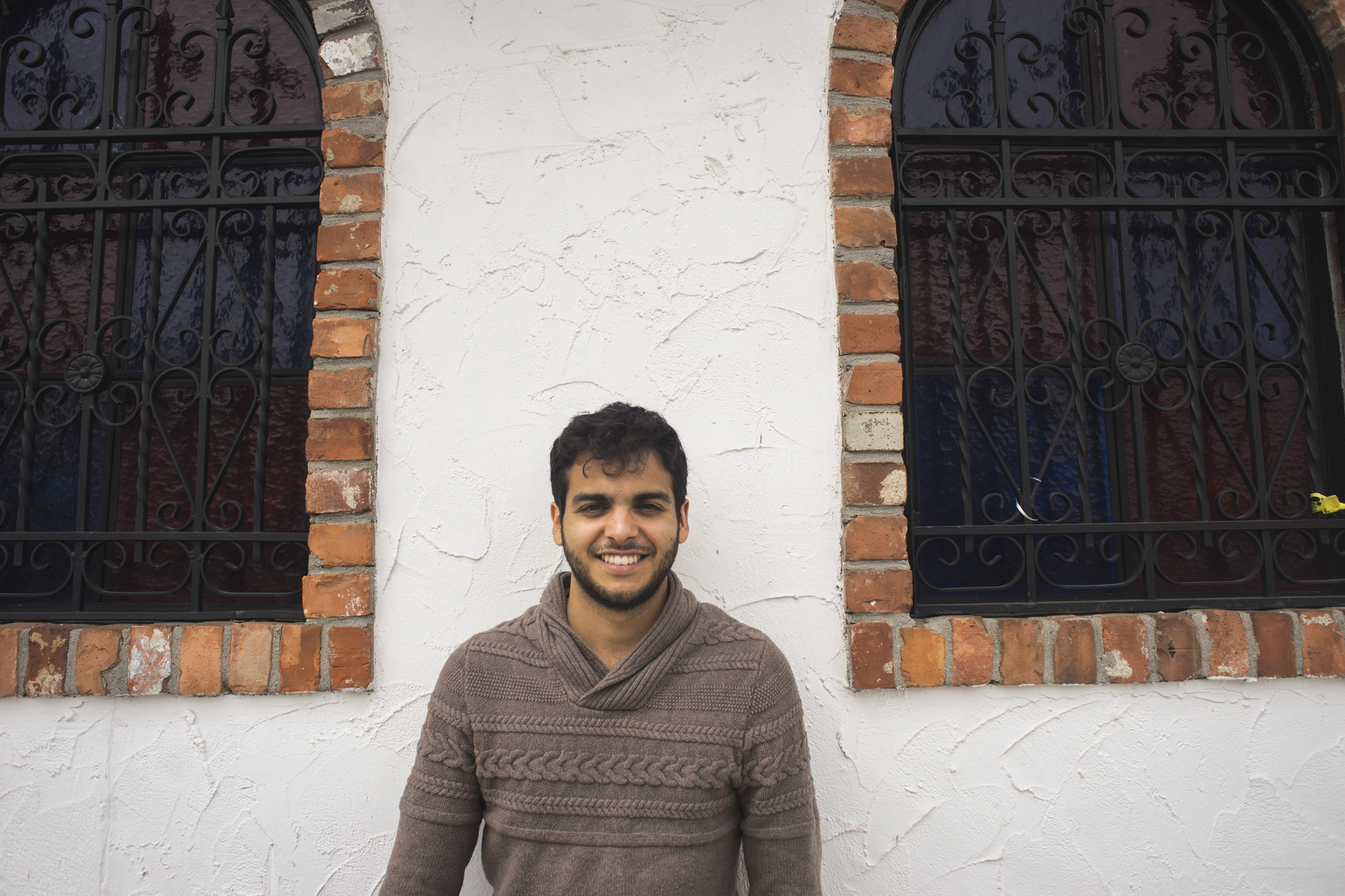
R&R (cont.d): Now, Emilio we understand that you did not start in Detroit, but came here after finishing up your undergraduate theatre degree at the University of California, Irvine. Would you mind telling us a bit about that?
Emilio: Of course! I moved here from Los Angeles, CA to work for Mumford High School in Northwest Detroit. I knew nothing about the city when I got here, but quickly found that I could work my day job and still have time for rehearsals — and I was paying far less money for a much larger apartment.
R&R: Is the cost of living what brought you here in the first place?
Emilio: No, I moved here as part of Teach for America.
R&R: Oh, so they chose Mumford High for you?
Emilio: Yes. And I was assigned to teach english, but their drama teacher had just left, so when they heard about my degree they me to teach drama; I said yes.
R&R: What was that experience like?
Emilio: Difficult, but rewarding. It was difficult because when I asked the school counselors to separate kids into lower level and advanced classes they still put them all together. And kids didn’t choose their schedules, counselors did. So I’d have kids of all ability levels in my class, and I had kids with no interest in performing while kids who really wanted the class couldn’t take it. Then, I’d have kids with a 1st grade reading level in a class with someone with a 12th grade reading level — and they’re all in 10th grade. The rewarding part was that some kids discovered their passion for theater, and they still call me for advice.
R&R: Interesting. So what are you doing now?
Emilio: Now I work with an organization called Wolf Trap which which brings arts education to children in Detroit public schools. I also had dreamt of playing Olivia in Twelfth Night; I got together with my good friend Bailey Boudreau (who wanted to play Viola) and made it happen. That’s how Slipstream Theater Initiative was born. Since then, I’ve done a lot of shows and teaching with Matrix Theatre Company, but most recently I was in Bad Jews at the Jewish Ensemble Theatre (running until June 14).
R&R: How would you advise people interested in doing arts education similar to your work with Wolf Trap?
Emilio: The Detroit public schools are a good place to start, since they are the least strict — especially if they don’t have to pay. In fact, they can’t pay, so you’d have to supply your own props, costumes, etc.
R&R: Will that work to engage the students as well as their families?
Emilio: Yes, it’s a great way to bring in more of an audience. And you have to start young, before people have told them it’s not cool to do theatre. I love working with five year olds because I say “act like a gorilla” and they just do it.
R&R: One last thing. We have observed most theatre in Detroit is attended by a predominately white audience base, yet the community itself is 82% African American. How would you suggest engaging with that majority?
Emilio: I would say do plays that take place now. A lot of black theater produced here is set in either the slavery era or segregation era; I think people want to see themselves represented as they are now. Also, include people of color both onstage and offstage: directors, playwrights, actors, everything. Things won’t change immediately, even though people expect that. I’ve seen people “experiment” with a contemporary play, then when it doesn’t work the first time and go back to the same stuff. It takes time for people to hear about the change.
R&R: Anything else?
Emilio: Yes. You have to seek out the right actor. For example, I saw a production of Motherfucker with the Hat by Stephen Adly-Guirguis recently, a play which requires a Latino actress. So they found a Latino non-actor who just was that role and it totally worked. They won’t necessarily come to you; it may take more time to find them, but it’s worth it.
R&R: Thanks so much, Emilio. You gave us a lot to think about and discuss.
Emilio: Of course, it was fun! Thanks.
“Gutenberg and Jobs make-out”
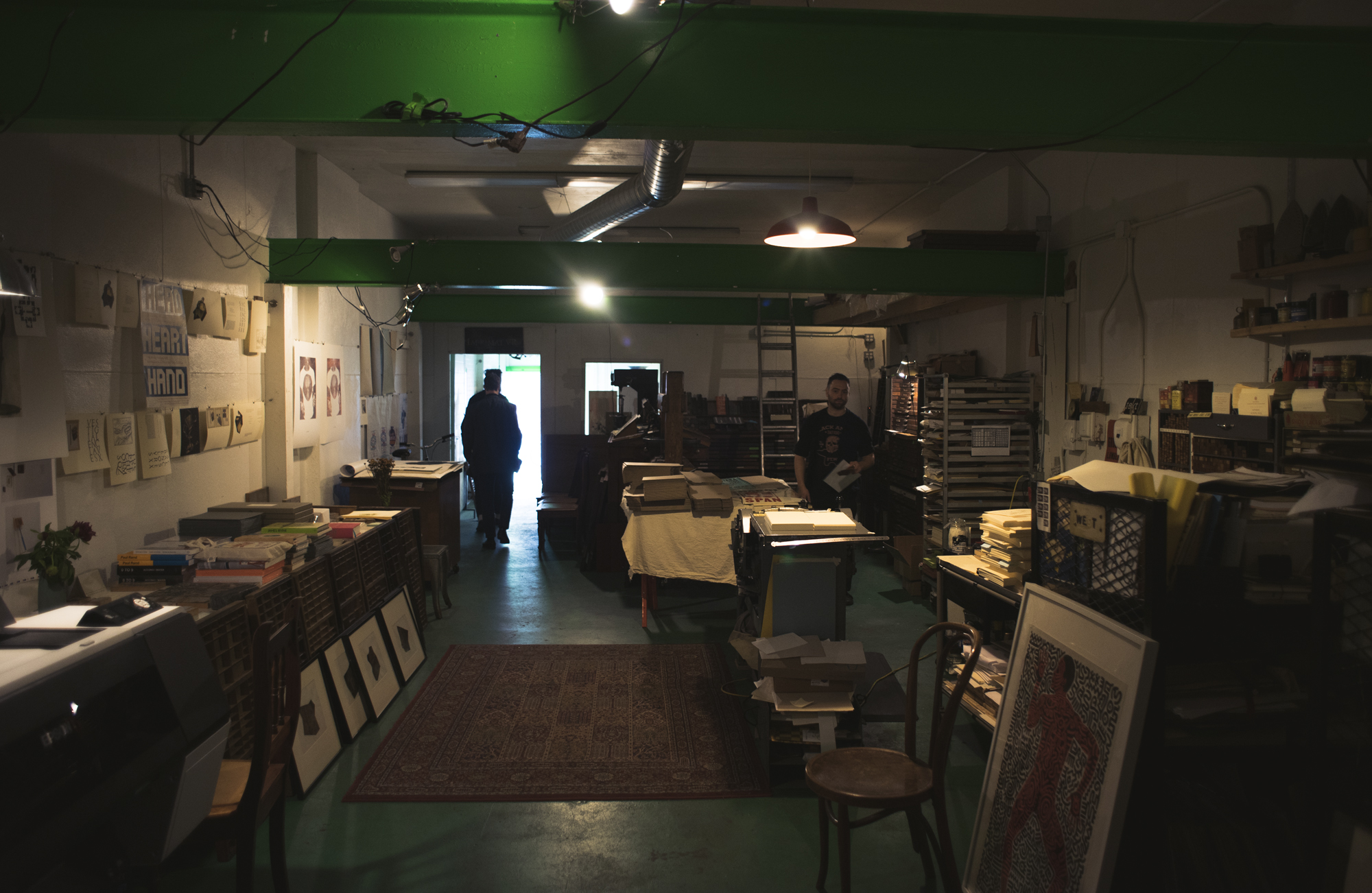
R&R: Now, we take you to Eastern Market to speak to Leon Johnson at Salt and Cedar. Leon, could you give us a bit of background on your storefront?

Leon: Sure. I’m from Cape Town. You know where that is?
Broadcaster: Southern Africa, correct?
Leon: South Africa, yes. We came here with no set idea of what we would do. Detroit taught us that. We work 20 hours a day as a fully functioning commercial press (doing business cards, fliers, etc) as well as an art press. We’re an event space, gallery, printing shop and we do dinner theatre in the back room — we’re looking to build a small black box upstairs. We’re just publishing our first book; we’re hand-binding it in the sixteenth century model. We can bind about three a day. It’s a It’s like a Gutenberg and Steve Jobs make-out session.
R&R: How many books are you binding?
Leon: This is the first edition, a soft-cover edition of 60, hard cover of 10 (that will take me 23 days minimum), then we will have an open-source PDF.
Broadcaster: Who wrote it?
Leon: It’s a book by Bill Harris, one of Detroit’s greatest poets, I commissioned it from him. It’s about the history of a certain part of Detroit.
R&R: Leon, do you think a theatre artist move to Detroit as opposed to New York, Chicago or Los Angeles?
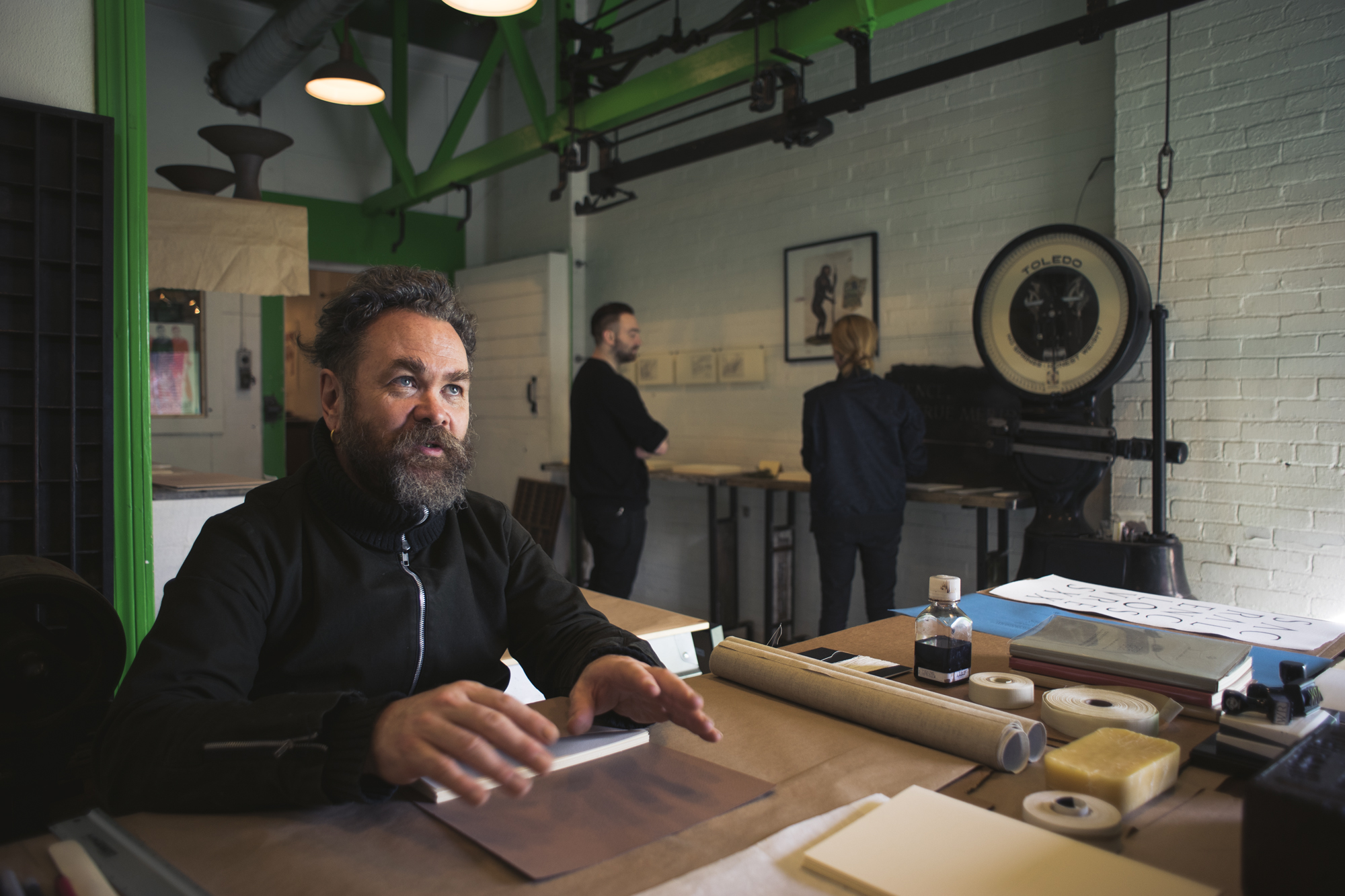
Leon: I think that that is not the right question to ask. Asking that, you’ll get a lot of knee-jerk responses from people trying to get people to come to their city — or they’ll just say yes out of default. I think the question needs to be more specific.
R&R: Alright. Do you think there’s an audience —
Leon: Why assume that there will be an audience? You have to build the audience based upon what you bring to the table.
R&R: What needs to be brought to the table?
Leon: I can’t answer that for you. Bring what you have and the audience will teach you what it needs. That’s what we did.
R&R: Thank you Leon. You can read more about Leon and his work here.
Let’s go there
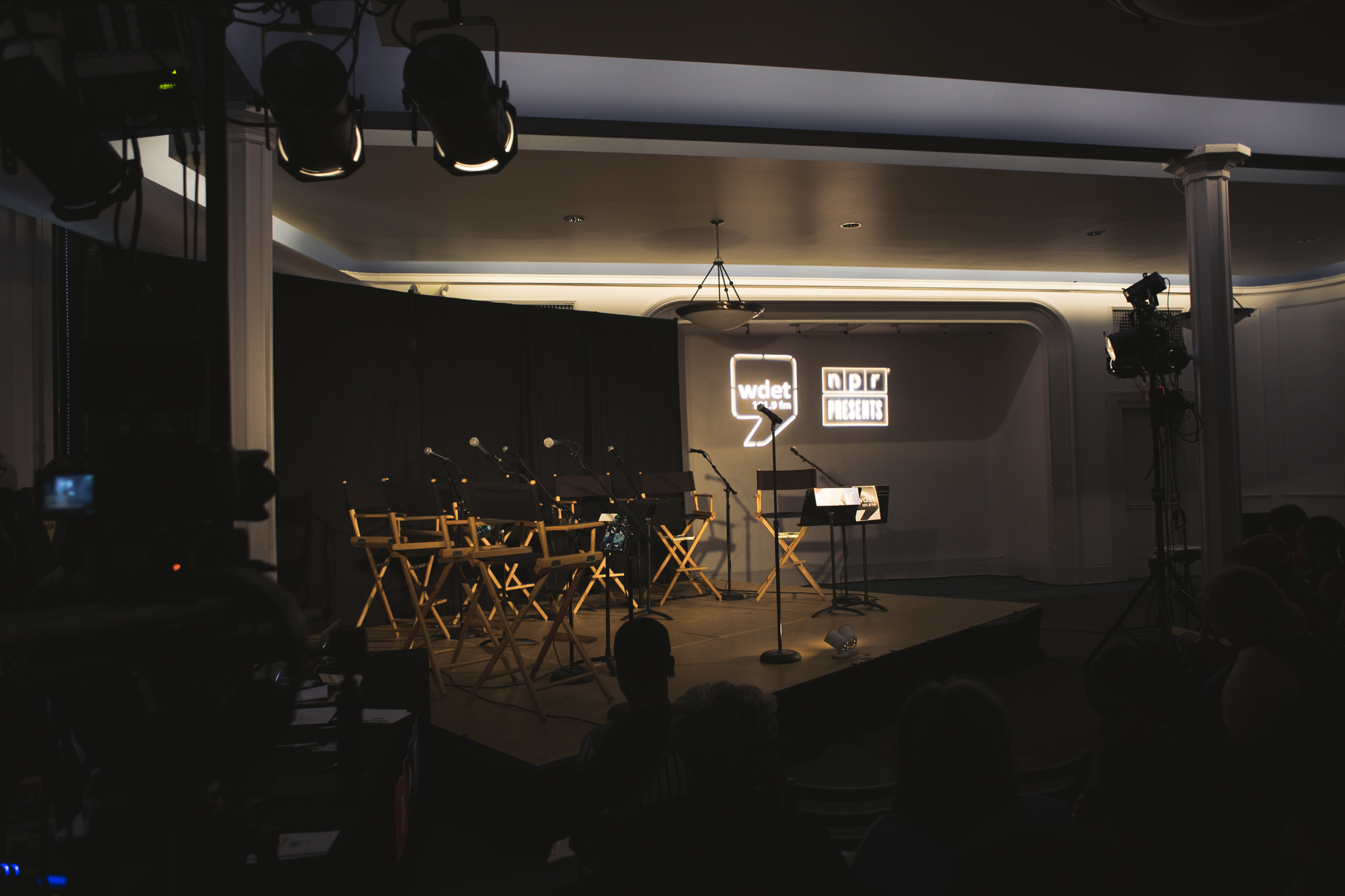
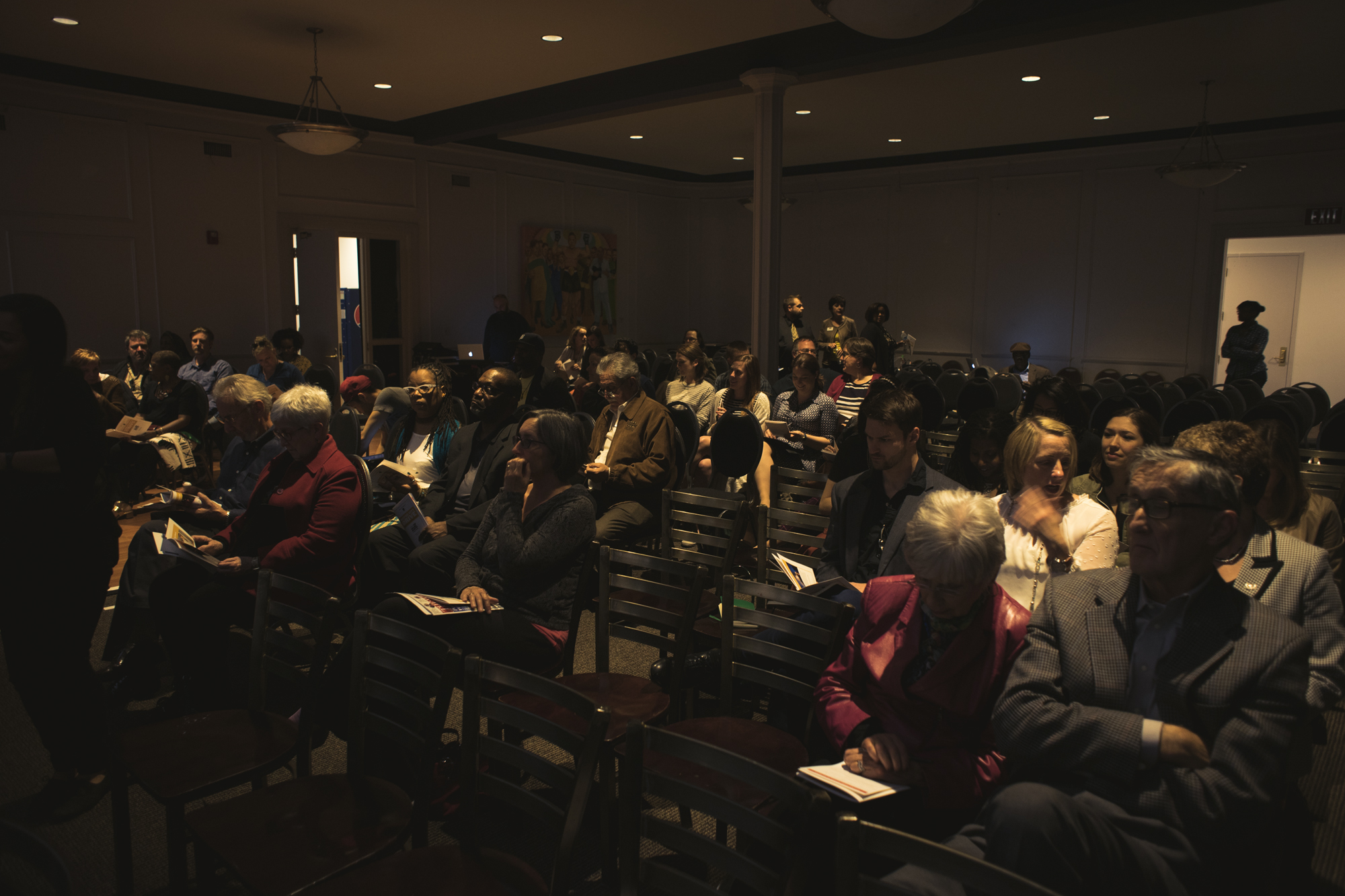
R&R: Now we bring you a reflection on Motor City Drive, a live event in NPR’s series Michel Martin Going There for which radio journalist Michel Martin travels around the US asking questions that matter. In this event, she comes to Detroit “to explore how artistic forces are helping to drive the Motor City forward. In collaboration with WDET, Martin brings together some of the city’s most innovative chefs, performers, artists and craftsmen at The Carr Center for a live, on-stage conversation that explores the many challenges and triumphs they’ve encountered while striving to redefine life in Detroit” (quoted from NPR’s website).

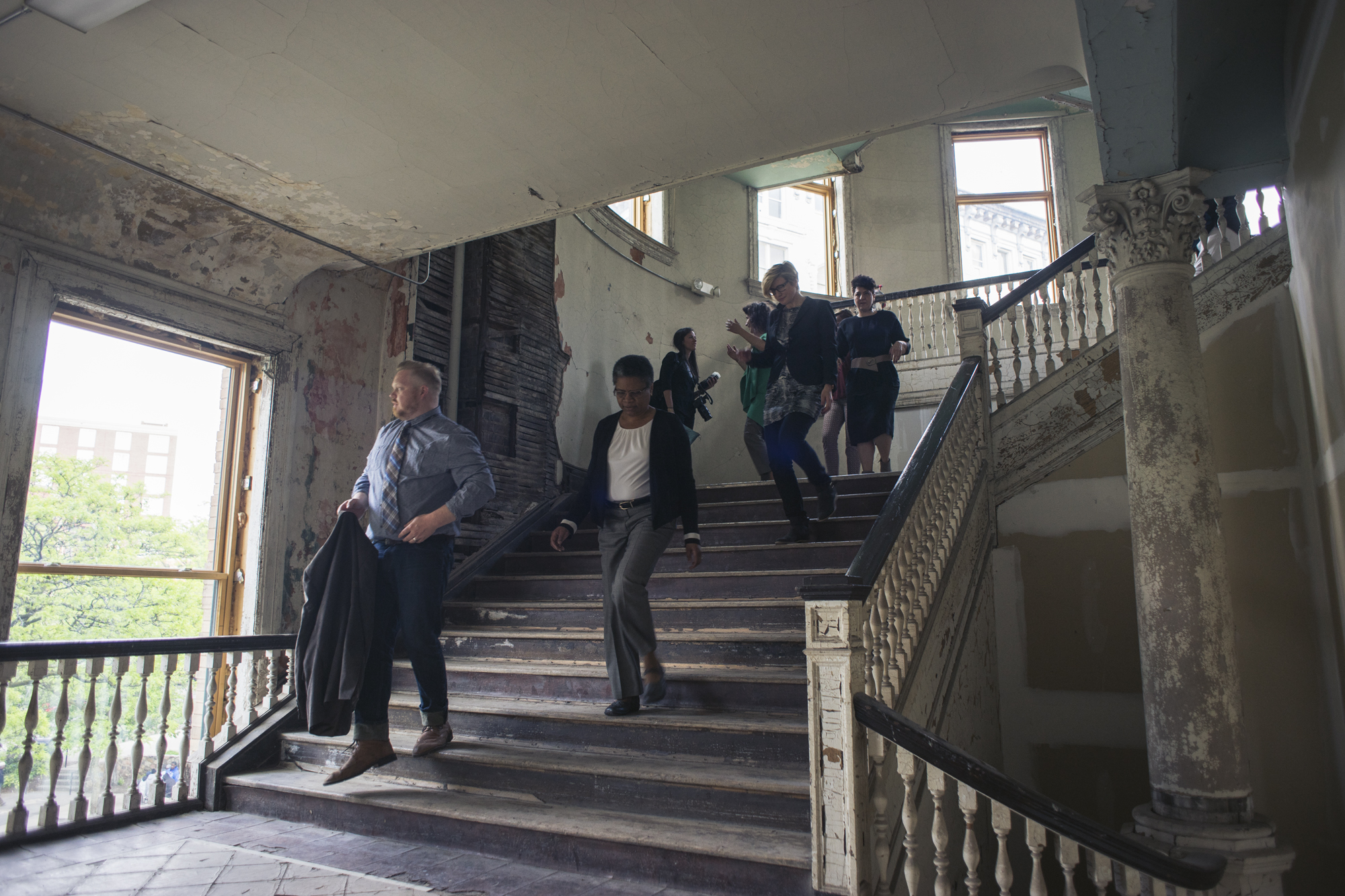
R&R (cont.d): Joining us today are Rory Gilbert and Ryan Lebar of Investigate Detroit who attended the event as part of their research.
So Rory: what were your take-aways from the NPR event?

Rory: Well, first I have to thank Brenda Terrell for telling us about the Carr Center’s upstairs theater before the event. She informed us that it’s a space that artists from the community can use for free. She explained this saying, “it gives them a place to work while giving us programming without the production costs”. Later on, we we asked Oliver Ragsdale (“the man with the keys and the bills” of the Carr Center, AKA the President) where we should open our theater he said “Here, upstairs. That was a dumb question.” Sounds like a plan to me! It’s a beautiful space with a lot of possibilities. It would at least give us a place to start before moving into our own building.

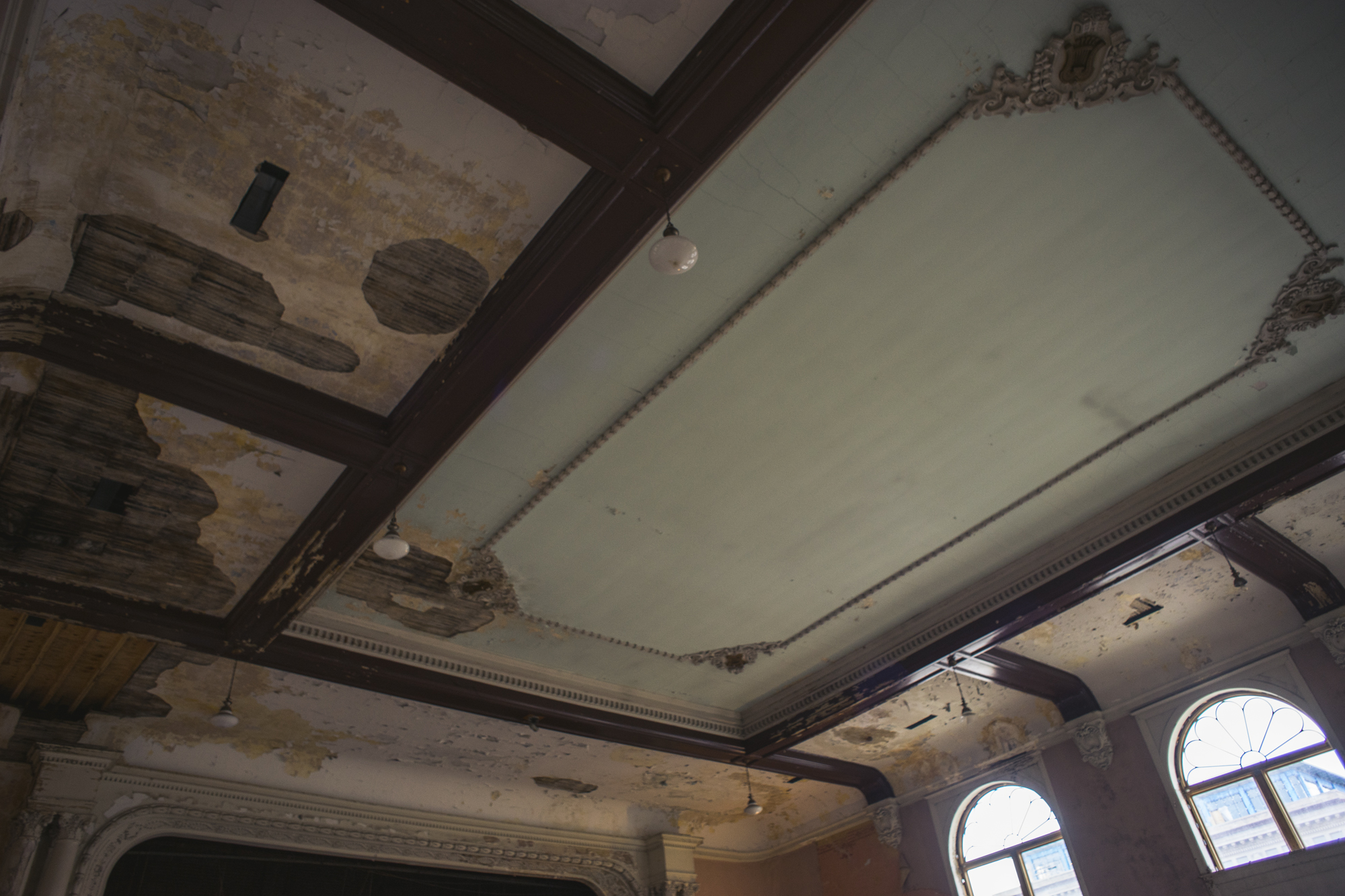
Rory (cont.d): As for the panel itself, I was quite moved by Jessica Care Moore’s poem at the beginning and her charged conversation later on. I respected her fearlessness, that she never held back from truly speaking her mind. However, WDET’s Travis Wright spoke seemingly directly to us when he said “If you’re planning on moving to Detroit as a creative you have some history lessons in front of you first. You have to understand that Detroit is a black city, it is a black south city. You have to understand it is an Arab city. You have to understand it is a city of activism it has hard core roots in all these facets, especially the activism…I think a lot of the creative work that happens in Detroit is rooted in activism, whether that’s community engagement or hardcore protest, that’s a piece of the creative puzzle that you have to take into consideration.”
R&R: Can you put that in the context of your work?
Rory: I am very interested in “community engagement” as Travis calls it, and I’m not averse to “hardcore protest” even. The thing that I’m latching onto is that we have to deal with race in order to not have to deal with it. What I mean is this: Oliver Ragsdale said “you’re part of the generation that doesn’t see race, but you’re living in a world that does”; this resonates with Rola Nashef’s statement when she said “my film is the first time we see second generation Arab Americans as normal.”
I do not care about race, therefor I usually speak freely about it. My problem is that I grew up in a place (as a South Carolinian and American) steeped in a history of oppression and discrimination; so the language and understanding of race I learned growing up are inherently problematic. But I’m learning now that the way to deal with it is not necessarily through conversation, but action. If we do work that takes for granted that “white” is not synonymous with “normal”; if we do plays that simply show nonwhites onstage living without making their ethnicity the piece’s central conflict; if we simply live our ideal, then we’ll be getting somewhere.
Of course, when it comes up we speak about it; but we do not need to chase the subject, because the truth is people are people. Period. This remark has seeds of conversation with Emilio Rodriguez, Charketa Glover, Samantha White, Dr. Kirk Goodlow and Dr. Martin Luther King Jr. among many others. The race issue can be solved in my life simply by letting it not be an issue
R&R: So do you mean that race is no longer an issue in the world?
Rory: Of course not: institutional racism is still real and insidious; I know out-and-out racists as well as closeted racists — even those who don’t know they’re racists (that’s possibly the most destructive). However, I can choose to build institutions that does not enact racism; I can be a person who questions my own thoughts of oppression quietly and brings the answers to bear when educating the next generation. And because of how things are, we must sometimes seek out actors of color simply because they may not come to us. According to a Detroit theatre director, at the smaller companies’ general auditions only about twenty headshots out of two hundred collected were “ethnic”. That means if I need an Arab actor for Merchant of Venice, to use Samantha White’s example, I can easily go to Dearborn (the largest Arab/Arab American population in the US) and ask around “have you ever thought about acting?”
Broadcaster: That’s all well and good. But how do you, as a white man running a theatre company, ensure that nonwhites feel comfortable entering into a contractual relationship with you?
Rory: I surround myself with people whose appearance and perspectives do not reflect mine. I allow them to affect my decision making. I actively seek to expand my limited awareness. But most of all, I listen.
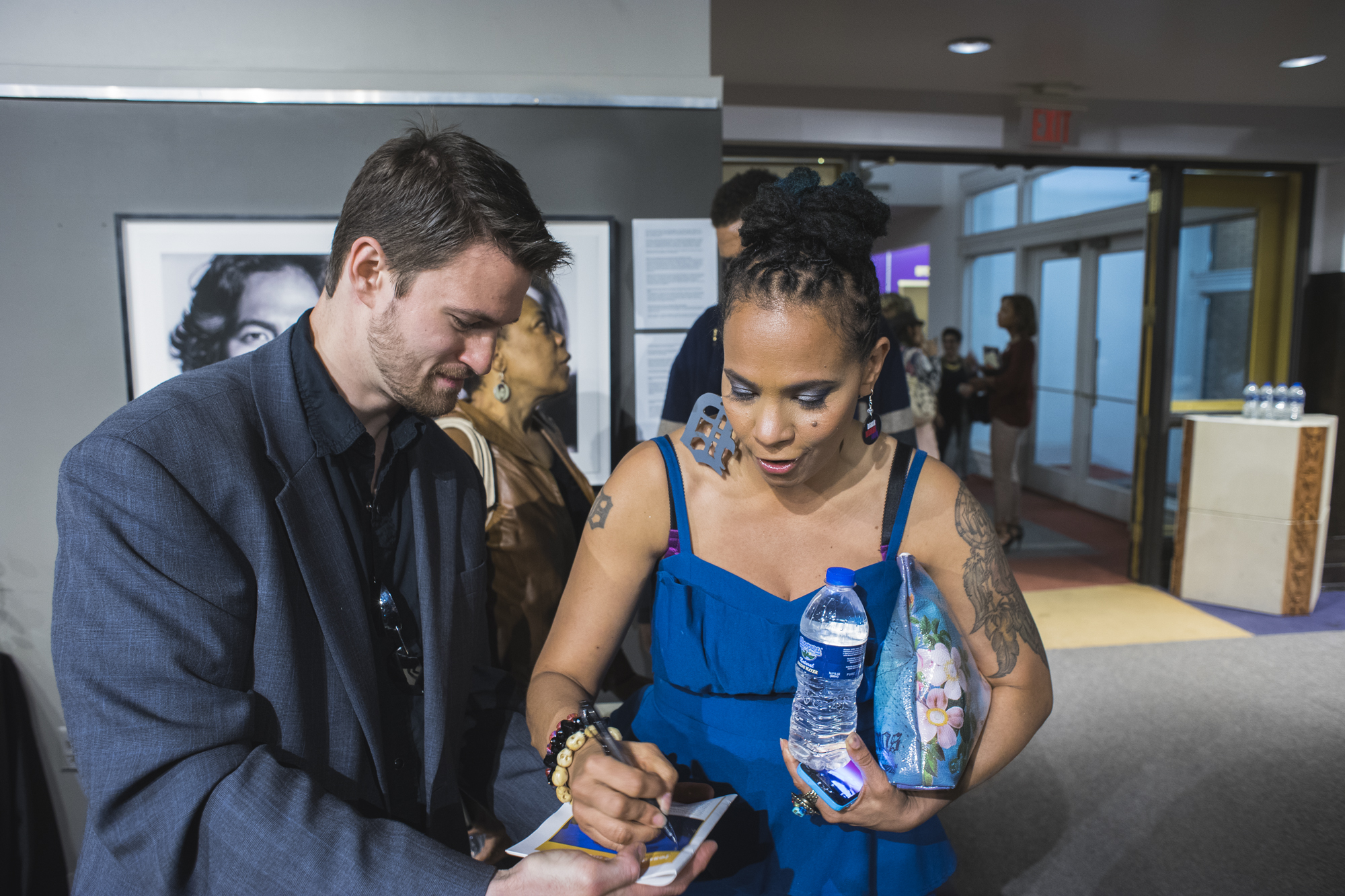
Rory with jessica Care moore
R&R Interesting. Ryan, what was your take on the event?
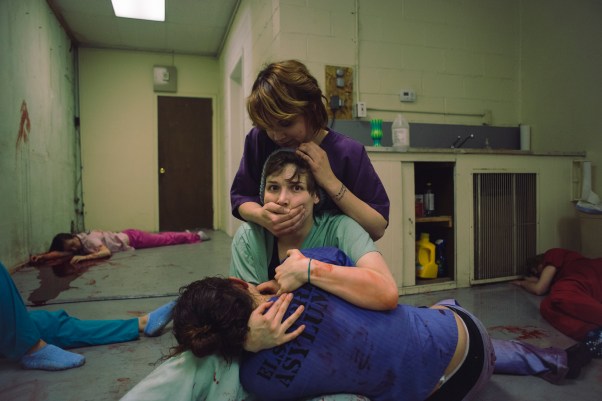
Ryan: So, I didn’t get to stay for the whole talkback since I had a prior commitment to take some photos for our friends at the Slipstream Theater Initiative.
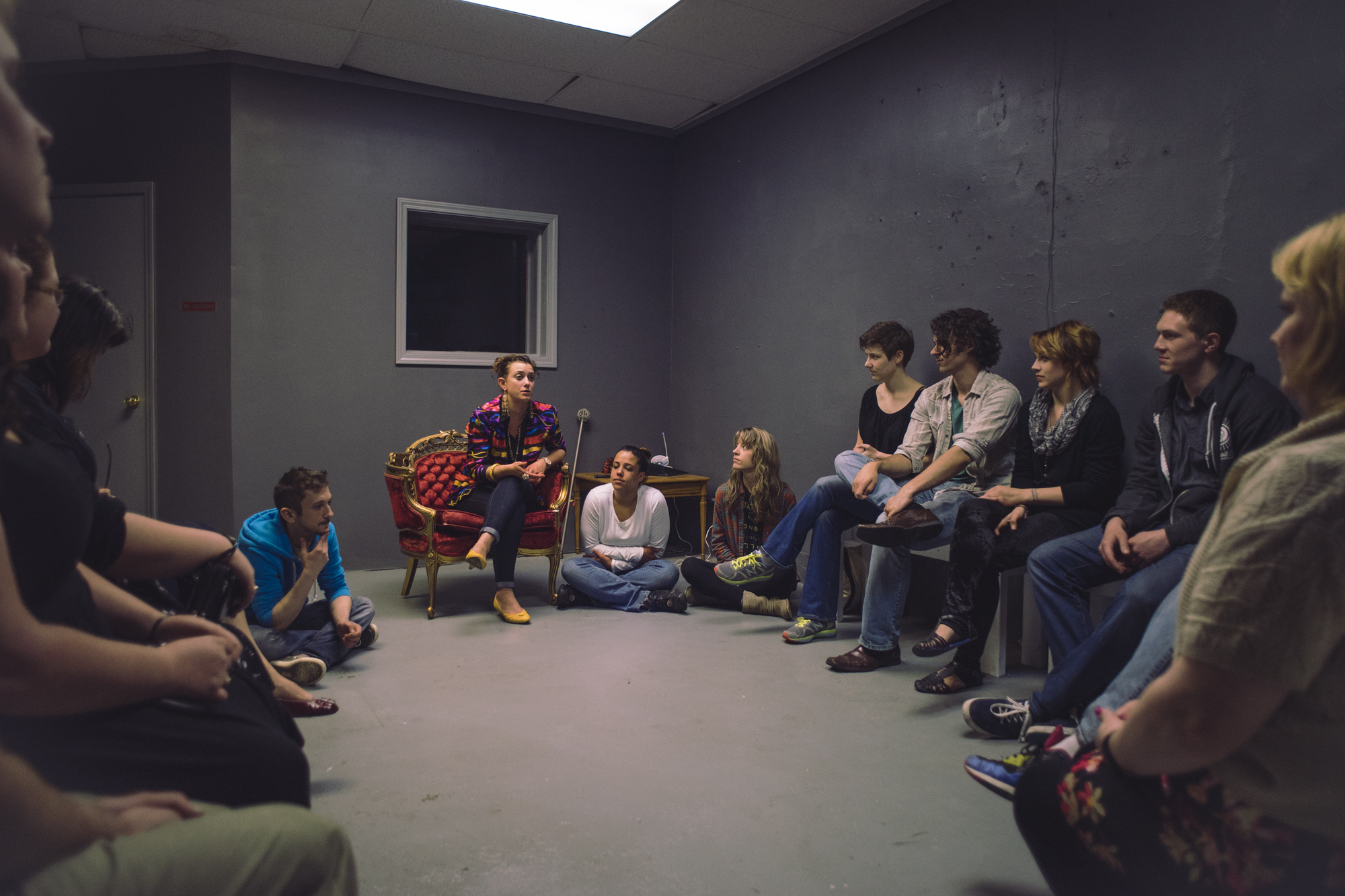
Slipstream’s talkback after Hamlet
Ryan (cont.d): They wanted some promo photos for their Hamlet production which we saw Day 5. But my take-away from these prolific artists working in Detroit paralleled what I have been learning from the Detroiters we have encountered. There is certainly a unique working mentality here unlike any other place I have been. People here work harder than any other city because they have no other choice. I think it’s rubbing off on us – I don’t think we’ve gone to bed before 3am this week. Being around people with that energy and dedication inspires me to work harder. I found a similar inspiration this year when I transferred to the Drama School at UNCSA.
Regarding some of the race issues we have been observing here, I am discovering my own ignorances. I was born to a non-Spanish-speaking Puerto Rican mother and an American non-orthodox Jewish father. This mix of backgrounds has lead me to identify partly with two different cultures and religions; still at first glance, I am pinned as a caucasian. After meeting Kirk and seeing our potential house, he told us that he didn’t think we would be coming back. Since then, he has told us repeatedly that “this sort of thing never happens” (two caucasians living with an African American in “the hood”.) Tonight at the Carr Center I saw “this sort of thing” again: people of every background, race, social class came to talk about the city’s state. The only other time we have seen this was at Sebastian’s Social Club when we got our hair cut. Interestingly enough, both of these organizations are run by African Americans. Hopefully wherever we end up starting whether it be in Detroit, NYC, Chicago, DC, LA, creates dialogue with all people. That’s really what this country is about, right?
R&R: You could argue that, yes. But back to the panel: what happened when you left?
Ryan: Well, I scooted out to Slipstream and took some photos.

Ryan (cont.d): When I was there, I met a woman who offered her keys to her brand new Jeep and told me to test drive it. By myself. So, I hopped in the car and took it around 8 mile for a few minutes. Could this have happened in any other city? Who knows…Thanks Jeep woman!

R&R: Hahaha…alright. Well thank you both for your time and your input.
Ryan: You’re welcome.
Rory: Of course, thank you for having us.
R&R: That’s all for tonight, folks. Thanks for tuning in!


The Michigan Station is being worked on!

 Should a Young Artist Move to Detroit?
4 thoughts on “Day 12: “Detroit is on fire””